Enter Password
A framework to expose gaps in persona knowledge
Clutterbot • 2025
Impact: Improved clarity in persona knowledge from 2.6 to 4.8
Role: Project Lead (Experience Designer)
A framework to expose gaps in persona knowledge
Clutterbot • 2025
Impact: Improved clarity in persona knowledge from 2.6 to 4.8
Role: Project Lead (Experience Designer)
A framework to expose gaps in persona knowledge
Clutterbot • 2025
Impact: Improved clarity in persona knowledge from 2.6 to 4.8
Role: Project Lead (Experience Designer)
A framework to expose gaps in persona knowledge
Clutterbot • 2025
Impact: Improved clarity in persona knowledge from 2.6 to 4.8
Role: Project Lead (Experience Designer)
SUMMARY
Making assumptions visible to reduce product risk
SUMMARY
Making assumptions visible to reduce product risk
SUMMARY
Making assumptions visible to reduce product risk
At Clutterbot, insights about our primary persona existed across multiple documents and past research outputs. Without a clear source of truth, these insights weren’t easy to find, reference, or build on, making it harder to confidently ground decisions in existing evidence. This created a real risk of decisions being shaped by assumptions rather than evidence.
At Clutterbot, insights about our primary persona existed across multiple documents and past research outputs. Without a clear source of truth, these insights weren’t easy to find, reference, or build on, making it harder to confidently ground decisions in existing evidence. This created a real risk of decisions being shaped by assumptions rather than evidence.
At Clutterbot, insights about our primary persona existed across multiple documents and past research outputs. Without a clear source of truth, these insights weren’t easy to find, reference, or build on, making it harder to confidently ground decisions in existing evidence. This created a real risk of decisions being shaped by assumptions rather than evidence.

The seven documents cited in a team survey as sources for the primary persona
The seven documents cited in a team survey as sources for the primary persona
To address this, I led a series of workshops to create a living persona framework – a single place where the team could find, update, and build on persona insights as we continued to learn about our users and shape the product.
The work led to two key outcomes:
Increased the team’s confidence in their understanding of the persona from 2.6 to 4.8 out of 5.
This gave the team a clear view of the highest-risk assumptions, guiding an in-market research initiative in San Francisco focused on solution and pricing validation.
To address this, I led a series of workshops to create a living persona framework – a single place where the team could find, update, and build on persona insights as we continued to learn about our users and shape the product.
The work led to two key outcomes:
Increased the team’s confidence in their understanding of the persona from 2.6 to 4.8 out of 5.
This gave the team a clear view of the highest-risk assumptions, guiding an in-market research initiative in San Francisco focused on solution and pricing validation.
To address this, I led a series of workshops to create a living persona framework – a single place where the team could find, update, and build on persona insights as we continued to learn about our users and shape the product.
The work led to two key outcomes:
Increased the team’s confidence in their understanding of the persona from 2.6 to 4.8 out of 5.
This gave the team a clear view of the highest-risk assumptions, guiding an in-market research initiative in San Francisco focused on solution and pricing validation.
SITUATION
A fragmented persona…
SITUATION
A fragmented persona…
SITUATION
A fragmented persona…
Clutterbot operates as a fast-moving startup where tools, workflows, and project scopes evolve quickly. In environments like this, documentation hygiene can easily slip, and over time knowledge becomes distributed across multiple places.
As a result of this fragmentation, a survey within the Experience team showed low confidence in our understanding of our primary persona and our knowledge gaps, with an average rating of 2.6 out of 5.
Clutterbot operates as a fast-moving startup where tools, workflows, and project scopes evolve quickly. In environments like this, documentation hygiene can easily slip, and over time knowledge becomes distributed across multiple places.
As a result of this fragmentation, a survey within the Experience team showed low confidence in our understanding of our primary persona and our knowledge gaps, with an average rating of 2.6 out of 5.
Clutterbot operates as a fast-moving startup where tools, workflows, and project scopes evolve quickly. In environments like this, documentation hygiene can easily slip, and over time knowledge becomes distributed across multiple places.
As a result of this fragmentation, a survey within the Experience team showed low confidence in our understanding of our primary persona and our knowledge gaps, with an average rating of 2.6 out of 5.
COMPLICATION
… puts product decisions at risk
COMPLICATION
… puts product decisions at risk
COMPLICATION
… puts product decisions at risk
At an early stage of product development, a clear understanding of the user is foundational. Without it, aligning on priorities and making confident product decisions becomes much more difficult.¹²³
We needed a system to make our current knowledge visible, identify gaps, and guide where research should focus next.
At an early stage of product development, a clear understanding of the user is foundational. Without it, aligning on priorities and making confident product decisions becomes much more difficult.¹²³
We needed a system to make our current knowledge visible, identify gaps, and guide where research should focus next.
At an early stage of product development, a clear understanding of the user is foundational. Without it, aligning on priorities and making confident product decisions becomes much more difficult.¹²³
We needed a system to make our current knowledge visible, identify gaps, and guide where research should focus next.
QUESTION
How might we create a clear, shared view of what we know and don’t know about our primary persona…
QUESTION
How might we create a clear, shared view of what we know and don’t know about our primary persona…
QUESTION
How might we create a clear, shared view of what we know and don’t know about our primary persona…
… so we can easily find and update knowledge, and focus research where it matters most?
Designing the framework meant answering three key questions:
Purpose: What did the framework need to achieve, and therefore what information should it prioritise?
Presentation: How should the information be structured, and where should it live?
Knowledge consolidation: How could existing insights be efficiently gathered and synthesised from past documents and research?
These challenges shaped the approach I took to designing the framework.
… so we can easily find and update knowledge, and focus research where it matters most?
Designing the framework meant answering three key questions:
Purpose: What did the framework need to achieve, and therefore what information should it prioritise?
Presentation: How should the information be structured, and where should it live?
Knowledge consolidation: How could existing insights be efficiently gathered and synthesised from past documents and research?
These challenges shaped the approach I took to designing the framework.
… so we can easily find and update knowledge, and focus research where it matters most?
Designing the framework meant answering three key questions:
Purpose: What did the framework need to achieve, and therefore what information should it prioritise?
Presentation: How should the information be structured, and where should it live?
Knowledge consolidation: How could existing insights be efficiently gathered and synthesised from past documents and research?
These challenges shaped the approach I took to designing the framework.
ANSWER (PURPOSE)
We needed a proto persona
ANSWER (PURPOSE)
We needed a proto persona
ANSWER (PURPOSE)
We needed a proto persona
I began by speaking with members of the Experience team to understand what the framework should accomplish. These conversations revealed a shared priority: at this stage of product development, the goal wasn’t to define a complete picture of the user, but to make our current, high-level understanding explicit.
I began by speaking with members of the Experience team to understand what the framework should accomplish. These conversations revealed a shared priority: at this stage of product development, the goal wasn’t to define a complete picture of the user, but to make our current, high-level understanding explicit.
I began by speaking with members of the Experience team to understand what the framework should accomplish. These conversations revealed a shared priority: at this stage of product development, the goal wasn’t to define a complete picture of the user, but to make our current, high-level understanding explicit.
“What we really need help with is identifying what is known and unknown, and where to go from that.”
“What we really need help with is identifying what is known and unknown, and where to go from that.”
“What we really need help with is identifying what is known and unknown, and where to go from that.”
From these conversations, four core requirements became clear. The framework needed to:
Capture the most important insights at a high level
Make evidence traceable
Highlight knowledge gaps
Guide research prioritisation
These requirements pointed toward a proto persona rather than a polished, marketing-style artefact:
“Proto-personas help teams make explicit the assumptions they have about users so they can be tested and validated.”⁴
From these conversations, four core requirements became clear. The framework needed to:
Capture the most important insights at a high level
Make evidence traceable
Highlight knowledge gaps
Guide research prioritisation
These requirements pointed toward a proto persona rather than a polished, marketing-style artefact:
“Proto-personas help teams make explicit the assumptions they have about users so they can be tested and validated.”⁴
From these conversations, four core requirements became clear. The framework needed to:
Capture the most important insights at a high level
Make evidence traceable
Highlight knowledge gaps
Guide research prioritisation
These requirements pointed toward a proto persona rather than a polished, marketing-style artefact:
“Proto-personas help teams make explicit the assumptions they have about users so they can be tested and validated.”⁴
ANSWER (PRESENTATION)
Designed as a working tool, not a polished artifact
ANSWER (PRESENTATION)
Designed as a working tool, not a polished artifact
ANSWER (PRESENTATION)
Designed as a working tool, not a polished artifact
After conducting precedent research, a framework from HubSpot emerged as a strong starting point, which I adapted to fit our needs. It maps insights from the core jobs-to-be-done and related dimensions down to the persona’s motivations and behaviours, organised by risk. This structure makes it easier to prioritise the knowledge gaps with the greatest impact on product decisions.
After conducting precedent research, a framework from HubSpot emerged as a strong starting point, which I adapted to fit our needs. It maps insights from the core jobs-to-be-done and related dimensions down to the persona’s motivations and behaviours, organised by risk. This structure makes it easier to prioritise the knowledge gaps with the greatest impact on product decisions.
After conducting precedent research, a framework from HubSpot emerged as a strong starting point, which I adapted to fit our needs. It maps insights from the core jobs-to-be-done and related dimensions down to the persona’s motivations and behaviours, organised by risk. This structure makes it easier to prioritise the knowledge gaps with the greatest impact on product decisions.
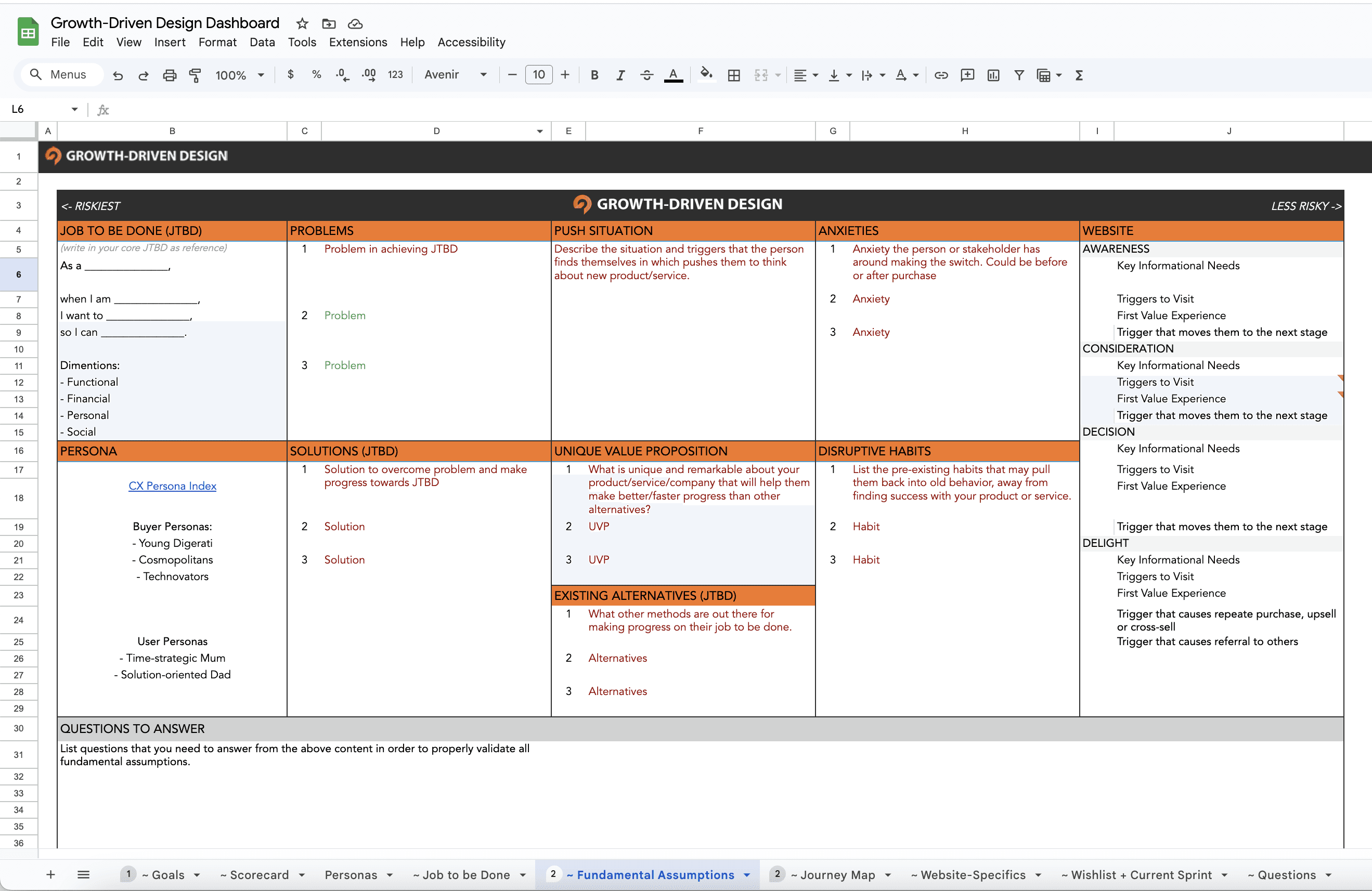
Although HubSpot implemented this structure in Excel, I chose Miro as the working platform because it best supported shared use and ongoing iteration.
Although HubSpot implemented this structure in Excel, I chose Miro as the working platform because it best supported shared use and ongoing iteration.
Although HubSpot implemented this structure in Excel, I chose Miro as the working platform because it best supported shared use and ongoing iteration.
ANSWER (KNOWLEDGE CONSOLIDATION)
Consolidating knowledge through workshops
ANSWER (KNOWLEDGE CONSOLIDATION)
Consolidating knowledge through workshops
ANSWER (KNOWLEDGE CONSOLIDATION)
Consolidating knowledge through workshops
Because a proto-persona is intended to surface a team’s current assumptions, reviewing every existing document would have been inefficient and misaligned with the goal.
Instead, I facilitated workshops to quickly externalise the team’s current understanding, align perspectives in real time, and create a shared starting point that could later be validated against research.
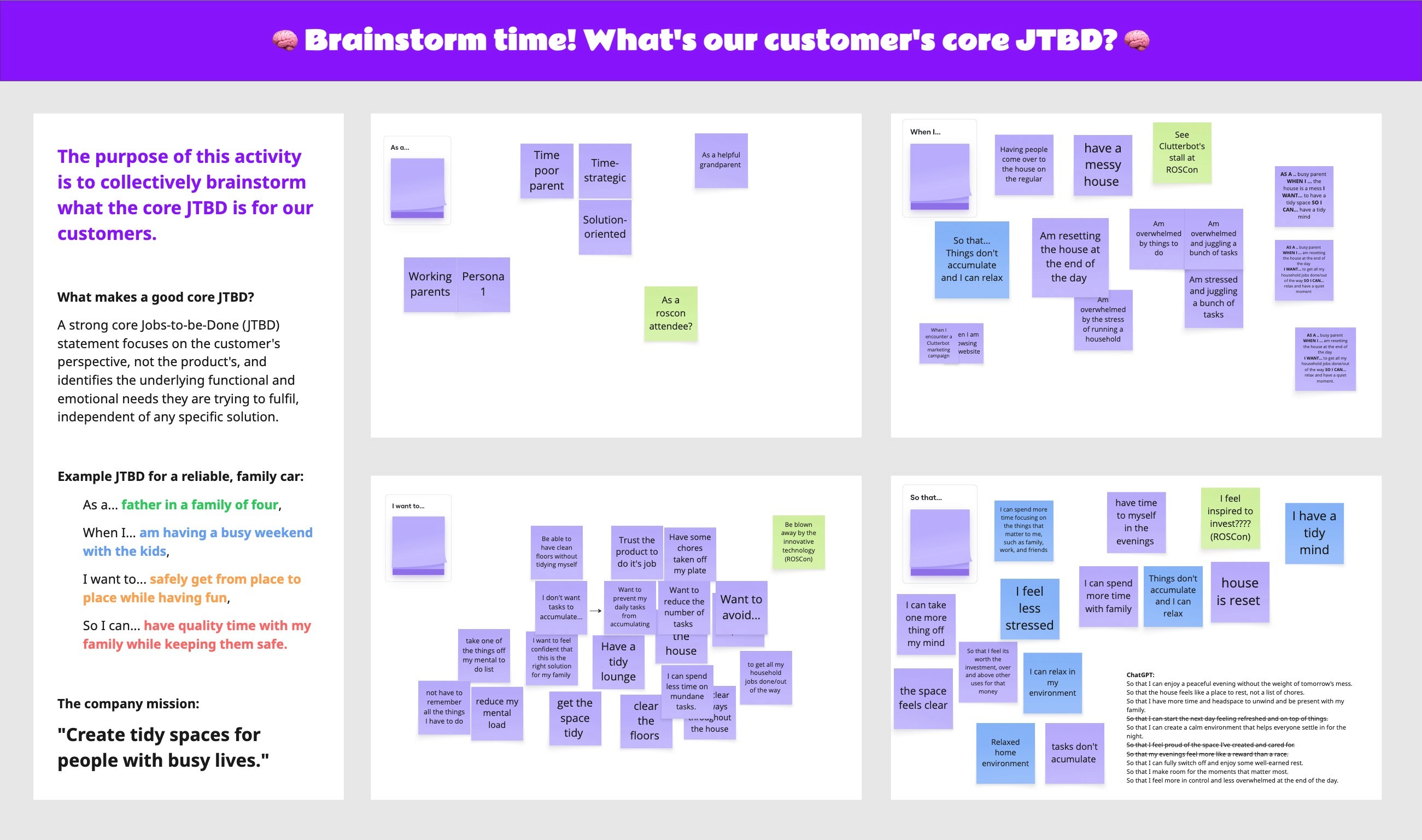
I planned and facilitated two 2-hour workshop sessions with the Experience team. During these sessions, we brainstormed key details about our persona and organised them into an affinity map.
Afterwards, I synthesised each cluster into clear, distinct insights and collaborated with the team to link them to existing documents and research.
Because a proto-persona is intended to surface a team’s current assumptions, reviewing every existing document would have been inefficient and misaligned with the goal.
Instead, I facilitated workshops to quickly externalise the team’s current understanding, align perspectives in real time, and create a shared starting point that could later be validated against research.
I planned and facilitated two 2-hour workshop sessions with the Experience team. During these sessions, we brainstormed key details about our persona and organised them into an affinity map.
Afterwards, I synthesised each cluster into clear, distinct insights and collaborated with the team to link them to existing documents and research.
Because a proto-persona is intended to surface a team’s current assumptions, reviewing every existing document would have been inefficient and misaligned with the goal.
Instead, I facilitated workshops to quickly externalise the team’s current understanding, align perspectives in real time, and create a shared starting point that could later be validated against research.
I planned and facilitated two 2-hour workshop sessions with the Experience team. During these sessions, we brainstormed key details about our persona and organised them into an affinity map.
Afterwards, I synthesised each cluster into clear, distinct insights and collaborated with the team to link them to existing documents and research.
OUTPUT
Introducing: The Persona Framework
OUTPUT
Introducing: The Persona Framework
OUTPUT
Introducing: The Persona Framework
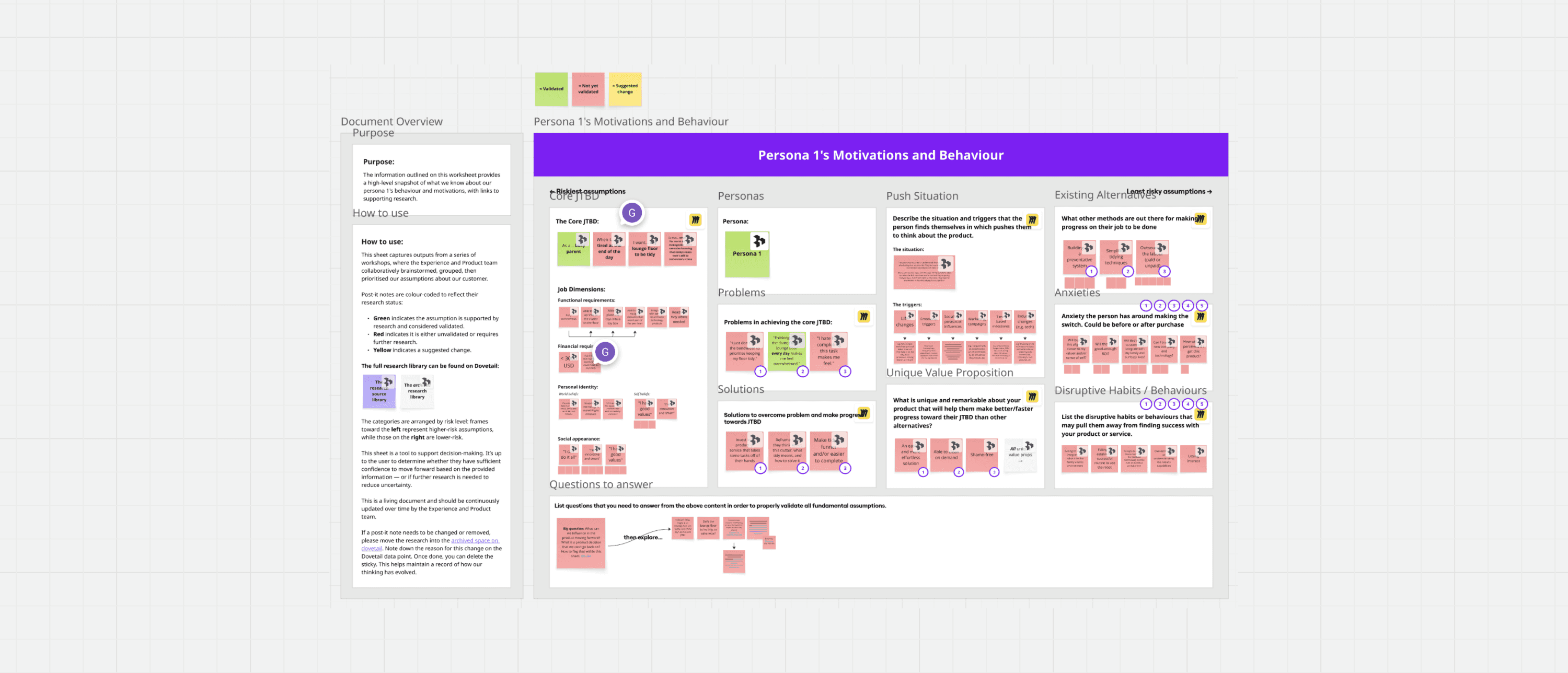
The output was a living persona framework that gives the team a clear, up-to-date view of what we know and don’t know about our primary persona. Insights are linked directly to supporting research, and confidence levels are visible at a glance, making it easier to track how our understanding evolves over time.
The output was a living persona framework that gives the team a clear, up-to-date view of what we know and don’t know about our primary persona. Insights are linked directly to supporting research, and confidence levels are visible at a glance, making it easier to track how our understanding evolves over time.
The output was a living persona framework that gives the team a clear, up-to-date view of what we know and don’t know about our primary persona. Insights are linked directly to supporting research, and confidence levels are visible at a glance, making it easier to track how our understanding evolves over time.
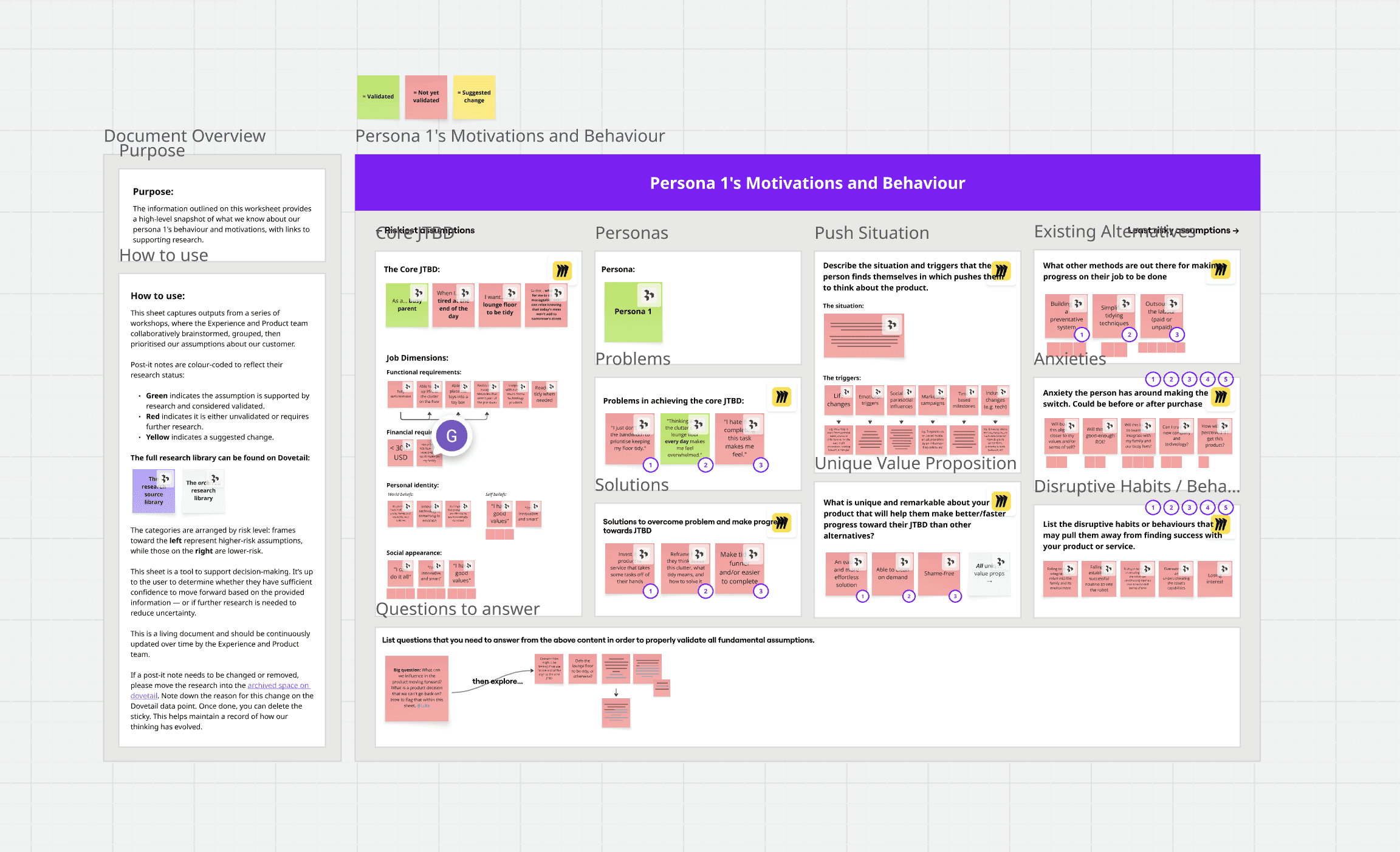
Two Dovetail boards support this system:
Two Dovetail boards support this system:
Two Dovetail boards support this system:
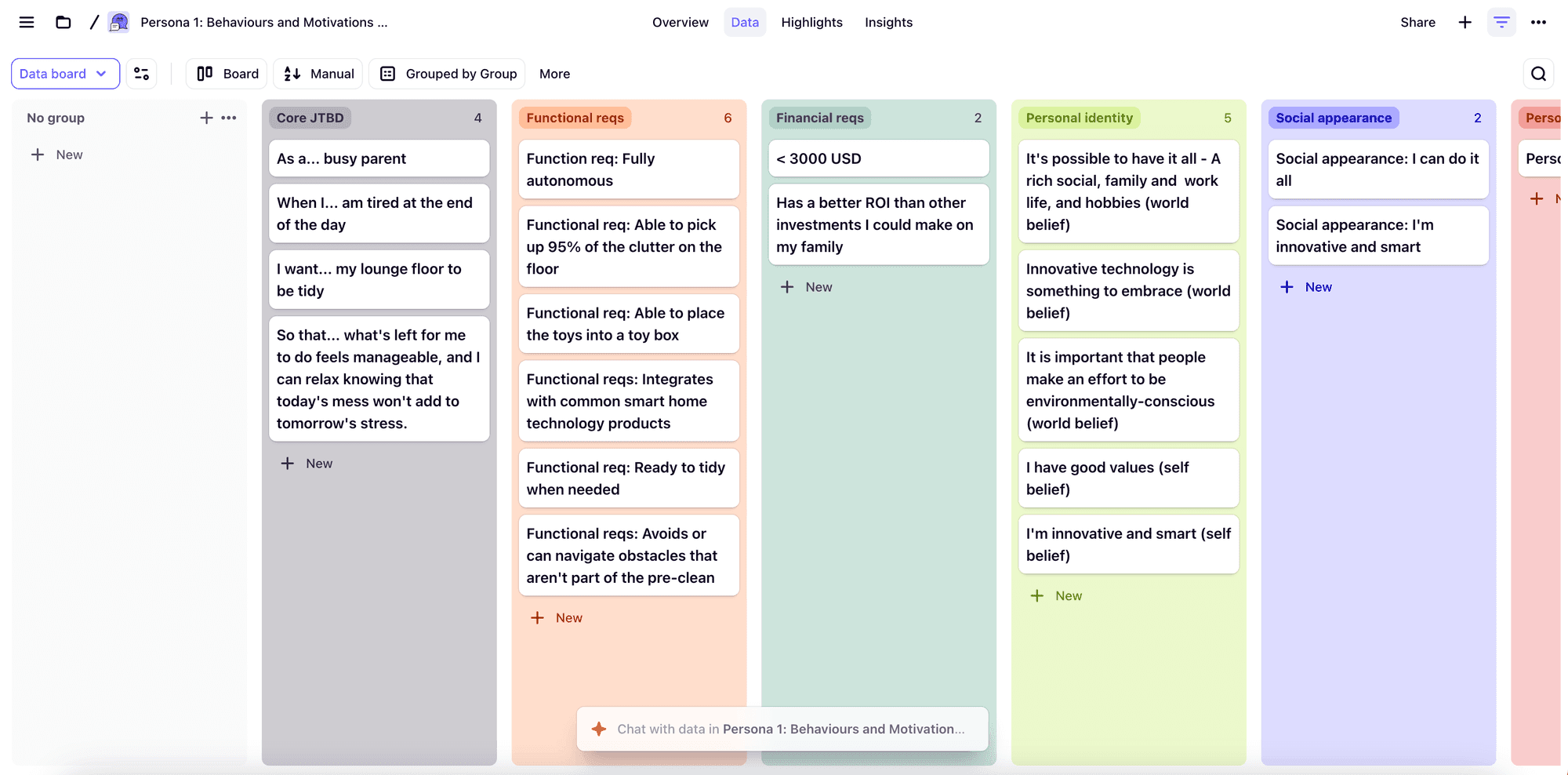
One contains active data and insights reflected on the Miro board, while the other serves as an archive. Insights that are later disproven or superseded are moved to the archive, allowing the team to preserve context while keeping the primary workspace current. This structure helps the team clearly track how our understanding of the persona evolves over time.
One contains active data and insights reflected on the Miro board, while the other serves as an archive. Insights that are later disproven or superseded are moved to the archive, allowing the team to preserve context while keeping the primary workspace current. This structure helps the team clearly track how our understanding of the persona evolves over time.
One contains active data and insights reflected on the Miro board, while the other serves as an archive. Insights that are later disproven or superseded are moved to the archive, allowing the team to preserve context while keeping the primary workspace current. This structure helps the team clearly track how our understanding of the persona evolves over time.
OUTCOME
From clarity to action
OUTCOME
From clarity to action
OUTCOME
From clarity to action
The framework significantly improved the team’s confidence in their understanding of the persona from 2.6 to 4.8 out of 5.
By surfacing the highest-risk assumptions, it also created a clear path for action and directly informed an in-market research initiative in San Francisco focused on solution and pricing validation.
The framework significantly improved the team’s confidence in their understanding of the persona from 2.6 to 4.8 out of 5.
By surfacing the highest-risk assumptions, it also created a clear path for action and directly informed an in-market research initiative in San Francisco focused on solution and pricing validation.
The framework significantly improved the team’s confidence in their understanding of the persona from 2.6 to 4.8 out of 5.
By surfacing the highest-risk assumptions, it also created a clear path for action and directly informed an in-market research initiative in San Francisco focused on solution and pricing validation.
LEARNINGS
Facilitation is about guiding thinking, not providing answers
LEARNINGS
Facilitation is about guiding thinking, not providing answers
LEARNINGS
Facilitation is about guiding thinking, not providing answers
This project showed me that effective facilitation isn’t about having all the answers – it’s about helping a group think together.
The goal of the workshops wasn’t to create a perfect or complete persona, but to build a shared understanding that was good enough to move forward, while recognising it would continue to evolve as we learned more.
Creating that alignment meant encouraging open discussion, asking probing questions, and repeating ideas to confirm shared understanding. This helped surface the reasoning behind each insight and uncover differences in perspective early, making it easier to reach clarity and align on next steps.
This project showed me that effective facilitation isn’t about having all the answers – it’s about helping a group think together.
The goal of the workshops wasn’t to create a perfect or complete persona, but to build a shared understanding that was good enough to move forward, while recognising it would continue to evolve as we learned more.
Creating that alignment meant encouraging open discussion, asking probing questions, and repeating ideas to confirm shared understanding. This helped surface the reasoning behind each insight and uncover differences in perspective early, making it easier to reach clarity and align on next steps.
This project showed me that effective facilitation isn’t about having all the answers – it’s about helping a group think together.
The goal of the workshops wasn’t to create a perfect or complete persona, but to build a shared understanding that was good enough to move forward, while recognising it would continue to evolve as we learned more.
Creating that alignment meant encouraging open discussion, asking probing questions, and repeating ideas to confirm shared understanding. This helped surface the reasoning behind each insight and uncover differences in perspective early, making it easier to reach clarity and align on next steps.
Resources
Resources
Resources
¹ Ries, E. (2011). The lean startup: How today’s entrepreneurs use continuous innovation to create radically successful businesses. Crown Business.
² Cagan, M. (2018). Inspired: How to create tech products customers love (2nd ed.). Wiley.
³ Norman, D. A. (2013). The design of everyday things: Revised and expanded edition. Basic Books.
⁴ UX Collective. (2019, April 15). How proto-personas improve UX discovery. UX Collective. https://uxdesign.cc/how-proto-personas-improve-ux-discovery-123456789
¹ Ries, E. (2011). The lean startup: How today’s entrepreneurs use continuous innovation to create radically successful businesses. Crown Business.
² Cagan, M. (2018). Inspired: How to create tech products customers love (2nd ed.). Wiley.
³ Norman, D. A. (2013). The design of everyday things: Revised and expanded edition. Basic Books.
⁴ UX Collective. (2019, April 15). How proto-personas improve UX discovery. UX Collective. https://uxdesign.cc/how-proto-personas-improve-ux-discovery-123456789
¹ Ries, E. (2011). The lean startup: How today’s entrepreneurs use continuous innovation to create radically successful businesses. Crown Business.
² Cagan, M. (2018). Inspired: How to create tech products customers love (2nd ed.). Wiley.
³ Norman, D. A. (2013). The design of everyday things: Revised and expanded edition. Basic Books.
⁴ UX Collective. (2019, April 15). How proto-personas improve UX discovery. UX Collective. https://uxdesign.cc/how-proto-personas-improve-ux-discovery-123456789
Thanks for coming by!
I’m always up for connecting with new people, so feel free to get in touch.
Thanks for coming by!
I’m always up for connecting with new people, so feel free to get in touch.
Thanks for coming by!
I’m always up for connecting with new people, so feel free to get in touch.
Thanks for coming by!
I’m always up for connecting with new people, so feel free to get in touch.